
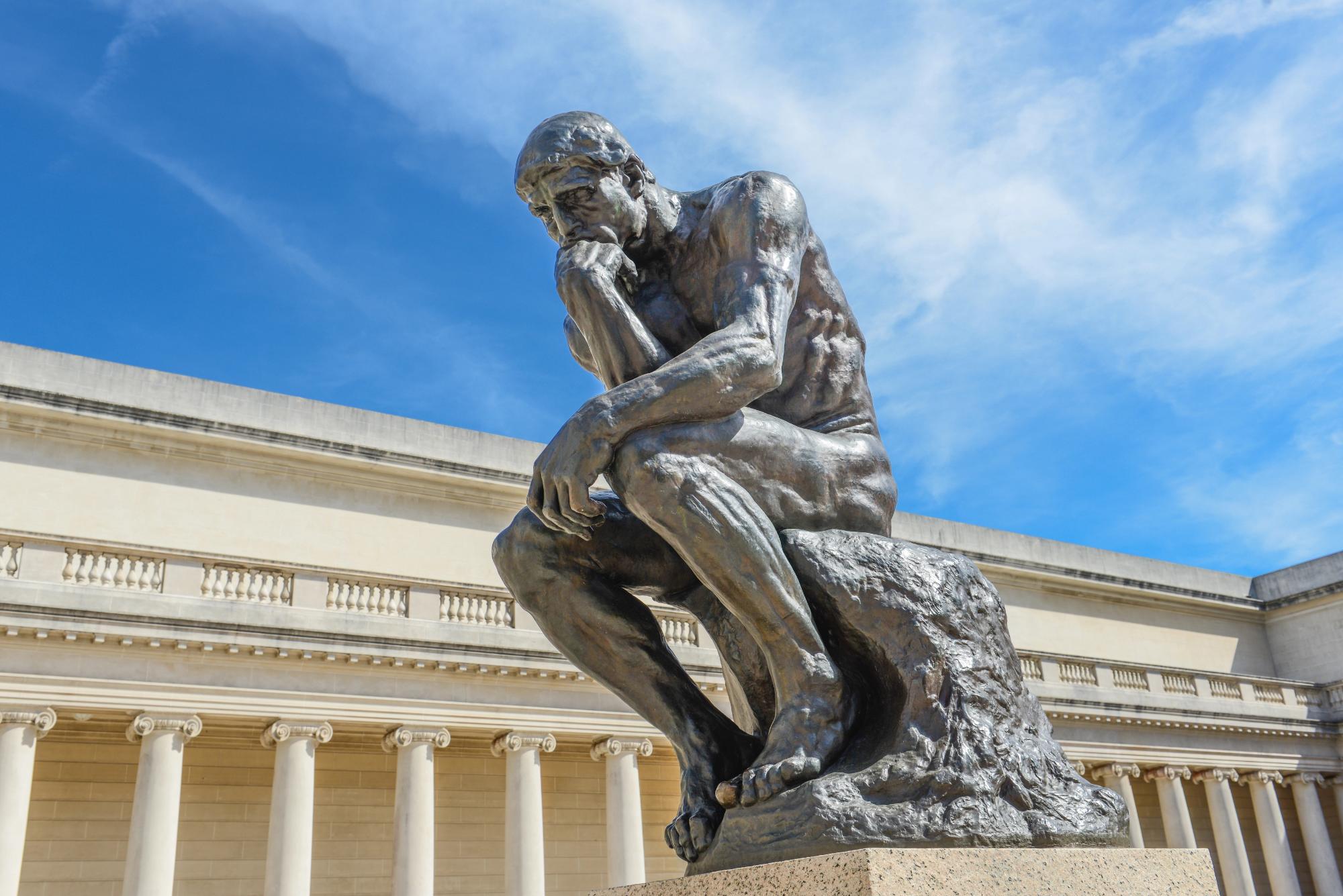
Every statue in Paris tells a story—if you know where to look.
Paris is often called an open-air museum—and for good reason. All across the city, statues grace its gardens, bridges, and plazas. They’re beautiful, sure. But here’s the truth most tourists don’t know: many of these public sculptures carry powerful messages, secret meanings, and even political statements.
Whether it’s a goddess staring into the Seine or a grieving figure tucked behind Notre-Dame, these works of art weren’t just made to impress—they were made to communicate.
Here are a few of Paris’s most fascinating sculptures—and the unexpected meanings behind them.
🏛️ 1. The Golden Statues of Pont Alexandre III
📍 Location: Pont Alexandre III, spanning the Seine between the Grand Palais and Hôtel des Invalides (8th arrondissement)
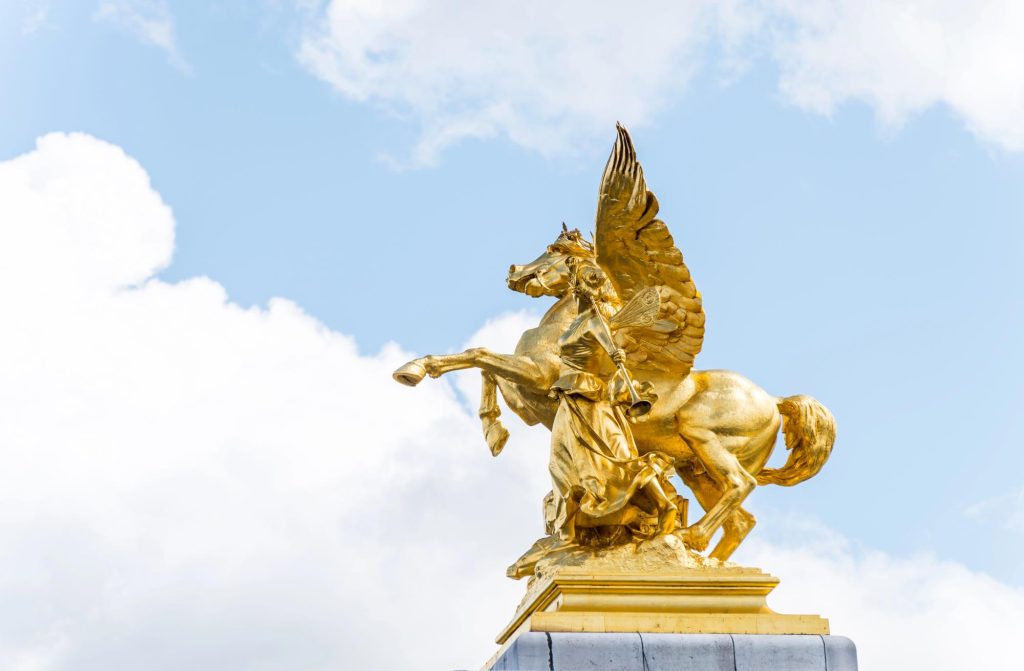
You’ve probably seen them before—shimmering in the background of Eiffel Tower selfies or sparkling above the Seine at golden hour. The statues that crown Pont Alexandre III aren’t just elegant—they’re loaded with symbolism.
This bridge, one of Paris’s most ornate, was built for the 1900 Exposition Universelle (World’s Fair)—a celebration of global innovation, peace, and progress. The entire structure was designed to be a showstopper, a visual representation of France’s cultural prestige and diplomatic strength.
At each end of the bridge stand four monumental golden statues, perched atop 17-meter-high pillars. These winged figures, often mistaken for generic angels or muses, actually represent four allegorical themes:
- The Arts
- Commerce
- Science
- Industry
In other words, the very foundations of France’s rebirth and power following the turmoil of the 19th century: the Revolution, the fall of empires, and the rebuilding of a modern republic.
And those dramatic winged horses? They symbolize freedom, ambition, and the forward motion of a nation determined to rise again.
🗝️ Hidden Meaning: These statues aren’t just decorative—they’re a golden proclamation that France, after a century of political chaos and bloodshed, has reclaimed its place as a leader in art, knowledge, and innovation.
📸 Pinterest Tip: Stand mid-bridge and shoot upward toward the statues at sunset—the light hits the gold leaf just right, giving you that dreamy glow. Bonus points if you frame the shot with the Eiffel Tower in the background for extra Pinterest power!
👂 2. “Écoute” – The Giant Head at Les Halles
📍 Location: Place René Cassin, right next to Saint-Eustache Church (1st arrondissement, near Les Halles) 🧠 Name translation: “Listen”
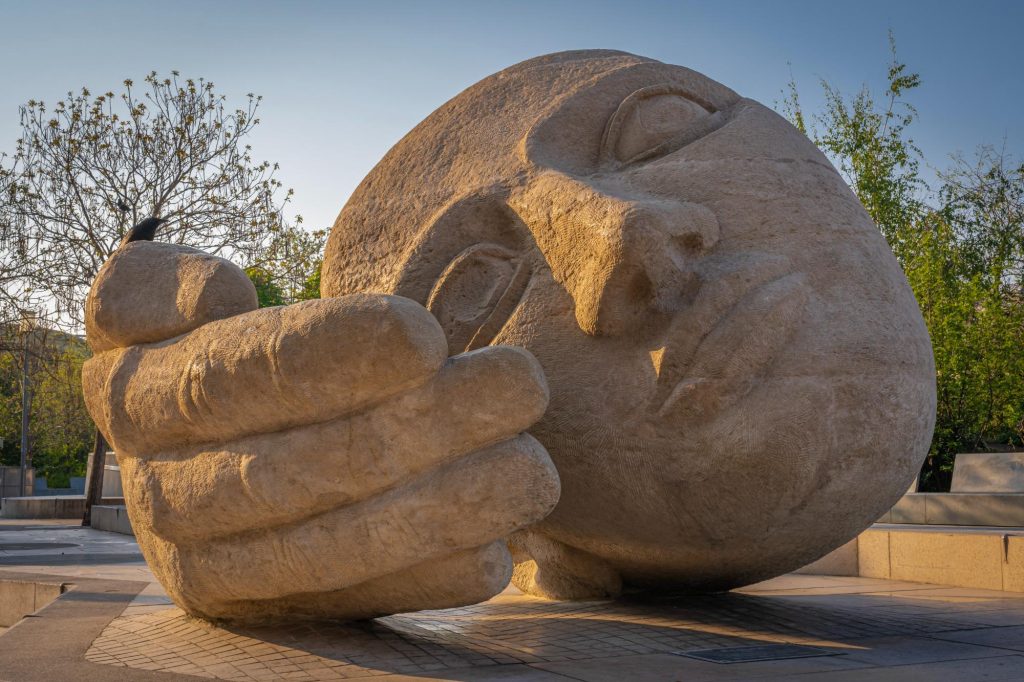
At first glance, it looks whimsical: a giant stone head resting peacefully in a quiet square, one ear pressed to the ground, eyes closed in deep concentration. Kids love to climb on it. Adults snap quick photos. But few stop to wonder what it really means.
“Écoute”, meaning “Listen”, was created by French sculptor Henri de Miller in the 1980s. It’s part of a duo—paired originally with another reclining figure (now removed)—and together they were designed to bring a sense of stillness to the heart of a fast-moving city.
But “Écoute” is more than a curious public artwork. It’s a meditative pause, frozen in stone.
Placed deliberately between the historic Église Saint-Eustache, a Gothic church dating back to the 16th century, and the modern glass-and-steel commercial complex of Les Halles, the sculpture marks a symbolic intersection:
- Past and future
- Sacred and secular
- Silence and noise
In the middle of this chaotic urban space—a hub of metro lines, shopping, street performers, and traffic—the head reminds us to tune in rather than tune out. Listen not just with ears, but with intention.
🗝️ Hidden Meaning: “Écoute” challenges the rhythm of the modern city. It’s a public call to slow down, to pay attention to what lies beneath the surface—whether it’s the echoes of history beneath your feet or the voice inside your own mind. In a society obsessed with motion, stillness becomes a radical act.
📸 Pinterest Tip: Frame the head from the front so the ear and hand are dominant in the shot—this creates a strong visual cue that immediately connects with the sculpture’s message. For creative shots, shoot from low to the ground to emphasize scale, or include Saint-Eustache in the background to highlight the contrast between ancient and modern.
🕊️ 3. The Monument to the Martyrs of the Deportation
📍 Location: Behind Notre-Dame Cathedral, at the tip of Île de la Cité 🛠️ Designer: Georges-Henri Pingusson, inaugurated in 1962
Just a few steps from the crowds and cameras of Notre-Dame, there’s a place almost no one sees. Walk to the very tip of the Île de la Cité, where the island narrows to a point, and you’ll find a discreet staircase leading underground. Most pass it by, unaware. But those who descend enter a different world—a space made not for tourists, but for remembrance.
This is the Monument to the Martyrs of the Deportation, built in memory of the 200,000 people—Jews, resistance fighters, Roma, political prisoners—who were deported from France to Nazi concentration camps during World War II.
Inside, it’s silent. Stark. Unforgiving. The walls are made of rough concrete. A narrow corridor stretches before you, lined with 200,000 illuminated glass crystals, each representing a life taken, a future erased.
There are no names, no statues, no grand architecture to soften the experience. Just bars, sharp angles, and a view of the Seine through iron gates—deliberately shaped like a prison cell. The geometry forces you into confrontation. You can’t walk side-by-side. You must enter alone.
🔍 Design Intent: Architect Georges-Henri Pingusson wanted the space to strip away distractions—to remove beauty, comfort, and ego—so that visitors could fully absorb the weight of absence. Even the light is subdued. It feels subterranean, like a tomb—but also like a warning.
🗝️ Hidden Meaning: This is a memorial to silenced voices. It doesn’t ask you to look—it demands that you feel. The stark emptiness echoes the void left behind by genocide. In a city of ornate monuments, this one whispers: Don’t forget.
📸 Pinterest Tip: Photograph the narrow corridor of lights or the barred opening to the Seine—frame it with shadows and let the emotion speak. Avoid selfies here; this is a space for solemnity, not spectacle. Instead, use text overlays like:
- “The Most Haunting Place in Paris”
- “200,000 Lights, One Silent Story”
👑 4. Marianne at Place de la République
📍 Location: Place de la République, 10th arrondissement 🗽 Sculptors: Léopold and Charles Morice, completed in 1883
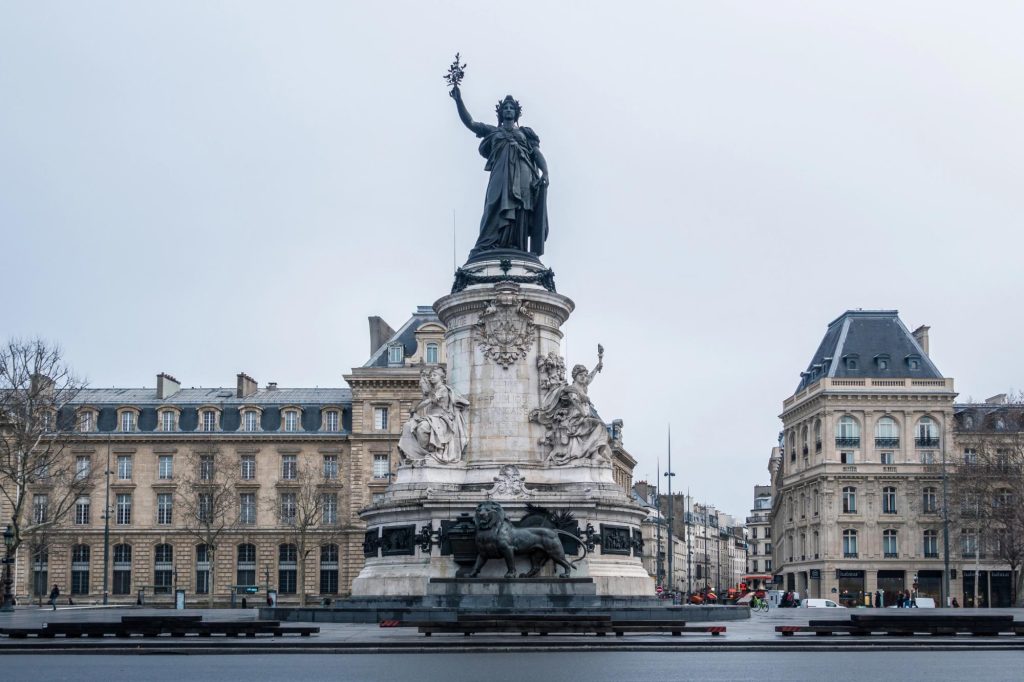
Towering over one of Paris’s largest public squares stands a woman carved from bronze—strong, solemn, unshakable. Her name is Marianne, and she is the very embodiment of the French Republic.
She’s not a mythological goddess or a historical queen. She’s a symbol: the spirit of Liberty, Equality, and Fraternity. Crowned with laurel leaves, holding a torch of enlightenment in one hand and the Declaration of the Rights of Man in the other, she rises above the square like a beacon for the people.
But Marianne isn’t frozen in the past. She lives in the heartbeat of modern France.
Over the decades, Place de la République has become the go-to space for protest, resistance, and national mourning. After the Charlie Hebdo attacks in 2015, thousands gathered here in silence, flowers and pens placed at Marianne’s feet. Again in 2023, amid political turmoil and protests over social justice, pension reforms, and civil rights, she stood surrounded by hand-painted signs, candles, and voices demanding change.
🧱 Around her base are stone reliefs representing key moments in French history—the Revolution of 1789, the abolition of slavery, the founding of the Republic. Lions guard the monument’s foundation. But it’s Marianne who watches over it all: fierce and maternal, unafraid and enduring.
🗝️ Hidden Meaning: Marianne isn’t just a statue—she’s a living stage for democracy. She reminds us that the ideals of the Republic aren’t finished. They’re still being fought for. Still being challenged. Still being redefined by the people in the streets around her. In a city of emperors and kings, Marianne belongs to the people.
📸 Pinterest Tip: Visit just after rainfall—when puddles collect on the pavement and create dramatic reflections of Marianne’s silhouette. Or come at sunrise for soft golden light that catches the reliefs in beautiful detail. Use overlays like:
- “The Woman Who Guards the French Republic”
- “Why This Paris Statue Is Always at the Center of Protest”
🎭 5. Camille Claudel’s Emotional Sculptures at Musée Rodin Garden
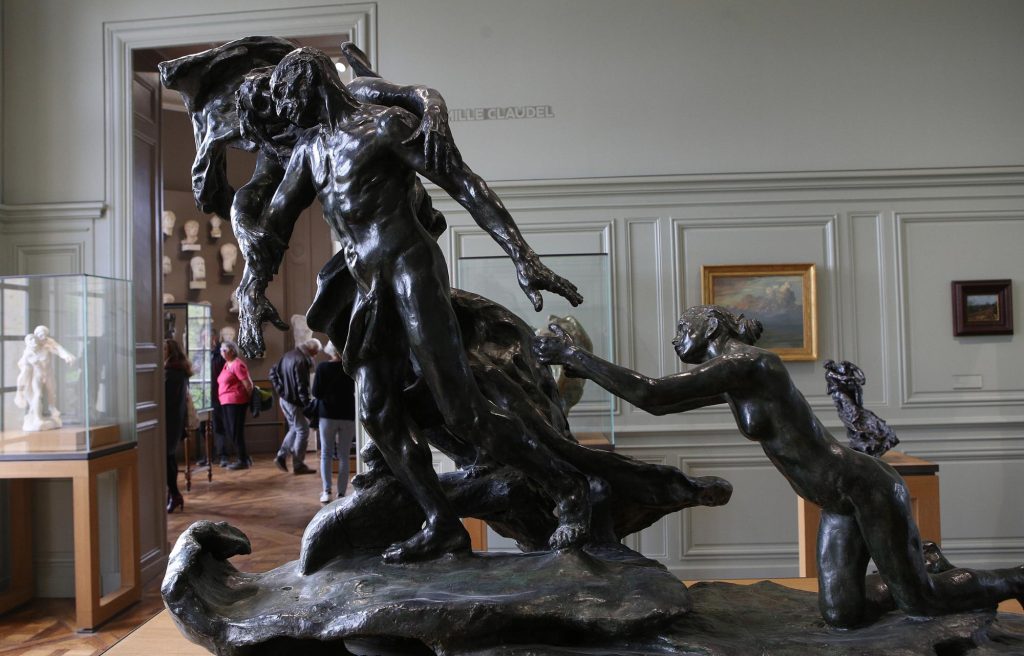
📍 Location: Musée Rodin, 77 Rue de Varenne, 7th arrondissement 🗿 Not fully public—but fully worth it
Tucked within the serene garden paths of the Musée Rodin, beneath weeping trees and marble giants, you’ll find sculptures that don’t just impress—they wound. These aren’t Rodin’s alone. They belong to Camille Claudel, one of the most gifted—and tragic—sculptors in French history.
Camille Claudel was more than a muse. She was Rodin’s student, collaborator, lover—and creative rival. Their relationship was as passionate as it was volatile, and its collapse mirrored her eventual spiral into isolation and institutionalization.
Her sculptures tell this story with raw, visceral emotion. Two of the most powerful examples on display:
💃 The Waltz (La Valse)
Two lovers in a swirling, suspended dance—intimate, vulnerable, unguarded. The woman’s body seems to melt into the motion, while the man holds her just firmly enough to let go. It’s sensual, yes—but also uncertain. Will they keep spinning, or fall apart?
🪨 The Age of Maturity (L’Âge mûr)
Perhaps Claudel’s most heart-wrenching piece. A cloaked older man is led away by an aged woman—while a younger, naked woman (often interpreted as Claudel herself) reaches toward him, pleading not to be left behind. It is abandonment, sculpted in bronze.
These works are emotionally heavy and unflinchingly personal. They defy the decorative expectations of sculpture in the 19th century and speak instead of grief, obsession, and creative hunger.
🗝️ Hidden Meaning: Camille Claudel’s sculptures are self-portraits in disguise—not of her face, but of her soul. In a time when women weren’t expected to speak publicly, much less shape marble, Claudel carved her pain, defiance, and longing into form. Her work is not just art—it’s emotional autobiography.
📸 Pinterest Tip: Zoom in on the hands, torsos, and movement of the figures rather than full-body shots. Emotion lives in the smallest gestures. Golden hour in the garden makes the bronze glow—ideal for warm, moody close-ups. Text overlay suggestions:
- “A Love Story in Stone”
- “Camille Claudel: The Forgotten Genius Behind Rodin
🚶♀️ Bonus: A Self-Guided Art Walk in Paris
Want to see them all in one day? Here’s a suggested walking route:
- Start at Place de la République
- Walk to Pont Alexandre III via Rue de Rivoli (stop at Jardin des Tuileries)
- Visit “Écoute” at Les Halles
- Continue to Notre-Dame + Monument to the Deportation
- End your day at the Musée Rodin garden
💡 Travel Tip: Grab a museum pass if you plan to visit multiple indoor spots like Rodin or Musée d’Orsay.
📌 Final Thoughts: Look Closer
Next time you’re in Paris, don’t just walk by the statues—ask what they’re trying to say. From golden goddesses to grieving ghosts, these works were built not just to decorate, but to communicate.
Want more hidden Paris secrets? Follow the board [“Paris Art & Meaning”] on Pinterest and pin this post to your Paris Travel board!
